

Fiber Trays for Meal Packaging Market Set to Reach USD 4.31 Billion by 2035
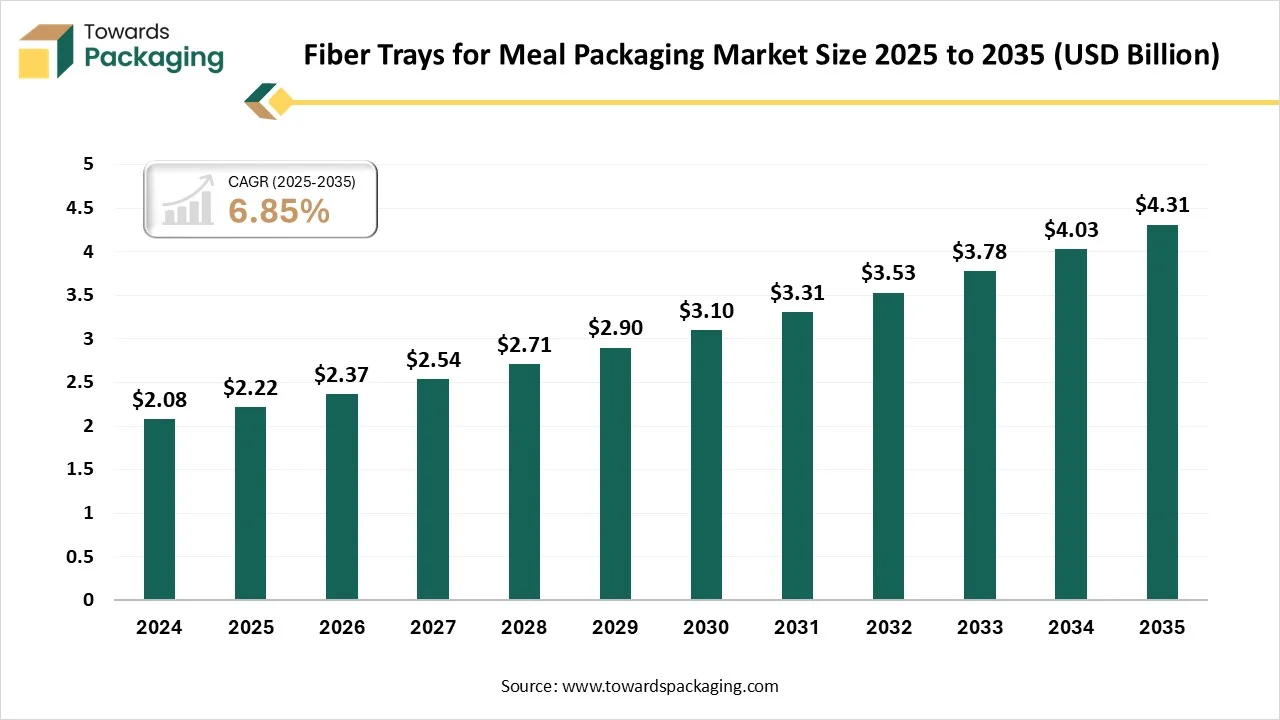
According to Towards Packaging consultants, the global fiber trays for meal packaging market is projected to reach approximately USD 4.31 billion by 2035, increasing from USD 2.22 billion in 2025, at a CAGR of 6.85% during the forecast period 2026 to 2035.
Ottawa, Feb. 18, 2026 (GLOBE NEWSWIRE) -- The global fiber trays for meal packaging market stood at USD 2.22 billion in 2025 and is projected to reach USD 4.31 billion by 2035, according to a study published by Towards Packaging, a sister firm of Precedence Research.
Request Research Report Built Around Your Goals: sales@towardspackaging.com
What is meant by Fiber Trays for Meal Packaging Market?
Fiber trays for meal packaging are molded containers made from natural fibers such as bagasse, recycled paper, or agricultural residues, designed to hold ready-to-eat or takeaway meals. They are lightweight, compostable, and suitable for hot or cold foods. The market is driven by rising environmental concerns, restrictions on single-use plastics, growth in food delivery services, and increasing demand from foodservice operators for sustainable, cost-effective packaging solutions.
Private Industry Investments for Fiber Trays for Meal Packaging:
- Huhtamaki’s North American Expansion: The company invested $18 million in 2024 to acquire Zellwin Farms Company, specifically to increase its molded fiber production capacity for the North American food industry.
- Stora Enso & Matrix Pack Partnership: In 2024, these two industry leaders entered a strategic partnership to co-develop and scale up sustainable formed fiber packaging technologies for meal and retail applications.
- Tekni-Plex's Ohio Facility: In 2024, Tekni-Plex launched a massive 200,000-square-foot molded fiber manufacturing plant in Ohio to significantly boost the production of sustainable trays and containers in the U.S.
- Fibmold's Ag-Waste Investment: This India-based startup secured $10 million in funding from firms like Accel in late 2023 to build facilities that upcycle agricultural waste into high-performance molded fiber meal packaging.
-
Tanbark Molded Fiber Funding: In early 2024, Tanbark secured financing to scale its wood-pulp-based compostable trays, aiming to replace traditional plastic meal containers using local timber resources.
Get All the Details in Our Solutions - Access Report Sample: https://www.towardspackaging.com/download-sample/5948
What Are the Latest Key Trends in the Fiber Trays for Meal Packaging Market?
Accelerated Shift Toward Sustainable and Compostable Materials
The industry is witnessing a structural transition from plastic and foam food containers to fiber-based trays made from recycled paper and agricultural residues. This shift is primarily driven by regulatory restrictions on single-use plastics and increasing consumer demand for environmentally responsible packaging. Fiber trays offer biodegradability, recyclability, and lower environmental impact, making them a preferred solution for foodservice operators.
Strong demand from ready-to-eat and Foodservice Segments
Growth in takeaway, on-the-go meals, and food delivery services is significantly increasing the need for lightweight, durable, and eco-friendly meal packaging. Fiber trays are gaining traction across restaurants, catering services, and retail food outlets because they provide adequate heat resistance, structural integrity, and sustainability benefits compared to conventional plastic packaging.
Technological Advancements in Melded Fiber Manufacturing
Ongoing innovations in molding technologies are enhancing tray strength, design precision, and barrier performance. Improved structural integrity and moisture resistance are expanding the use of fiber trays for hot, wet, or chilled foods. These advancements are enabling fiber packaging to compete more effectively with plastic alternatives across a broader range of food applications.
Increasing Regulatory Pressure and Corporate Sustainability Targets
Governments across multiple regions are enforcing policies to reduce plastic waste, prompting food brands and packaging companies to adopt biodegradable alternatives. At the same time, corporations are integrating sustainability goals into their packaging strategies, accelerating the shift toward fiber-based solutions that comply with environmental standards and support circular-economy initiatives.
Expansion of the Circular Economy and Recycled Fiber Utilization
Industry participants are increasingly focusing on closed-loop systems and the use of recycled or renewable raw materials. Fiber trays produced from post-consumer paper or agricultural waste support resource efficiency and reduce dependence on virgin plastics. This circular approach aligns with corporate sustainability commitments and evolving consumer expectations for environmentally responsible packaging.
What is the Potential Growth Rate of the Fiber Trays for Meal Packaging Industry?
The fiber trays for meal packaging industry are expected to witness steady and sustainable growth over the coming years, supported by multiple structural drivers. Rising environmental regulations and bans on single-use plastics are encouraging a shift toward biodegradable packaging. In addition, rapid expansion of online food delivery, growing consumer preference for eco-friendly materials, and technological improvements in molded fiber performance are collectively strengthening the market’s long-term growth potential.
More Insights of Towards Packaging:
- Lightweight Industrial Corrugated Packaging Market Size and Segments Outlook (2026–2035)
- Sustainable Aerosol Packaging Market Size, Trends and Segments (2026–2035)
- Poly-Woven Packaging Market Size, Trends, Segments, Companies, Competitive Analysis, Value Chain & Trade Analysis 2025-2035
- Mono-Material Cosmetic Tubes Market Growth, Trends & Forecast (2025-2035)
- U.S. Beer Packaging Market Size and Trend, Segment Outlook (2026–2035)
- Cold Chain Packaging Refrigerants Market Size, Trends and Segments (2026–2035)
- Packaging Adhesive Market Size, Trends and Regional Analysis (2026–2035)
- Heavy-Duty Corrugated Bulk Boxes Market Size and Segments Outlook (2026–2035)
- Next-Gen Paper & Fiber-Based Packaging Market Size, Trends and Regional Analysis (2026–2035)
- Flow Wrap Packaging Market Size, Trends and Competitive Landscape (2026–2035)
- India Molded Pulp Packaging Market Size, Trends and Segments (2026–2035)
- Clear Plastic Film Market Size, Volume, Price and Trends (2026 - 2035)
- Polyethylene Films Market Size, Trends and Volume (2026-2035)
- Thin Wall Packaging Market Size and Segments Outlook (2026–2035)
- Dunnage Packaging Market Size, Trends and Segments (2026–2035)
- Liquid Packaging Market Size and Segments Outlook (2026–2035)
- Food Packaging Market Size, Trends and Segments (2026–2035)
- U.S. Seed Packaging Market Size and Segments Outlook (2026–2035)
- Europe Pharmaceutical Glass Packaging Market Size, Trends and Segments (2026–2035)
- Uncoated Paperboard For Luxury Packaging Market Size, Trends, Share, Trends, Segments, and Regional Insights (NA, EU, APAC, LA, MEA)
Regional Analysis:
Who is the leader in the Fiber Trays for Meal Packaging Market?
Asia-Pacific dominates the market due to the abundant availability of agricultural residues such as bagasse, bamboo, and recycled paper, which serve as low-cost raw materials. Rapid growth in urban populations, expanding food delivery services, and increasing consumption of ready-to-eat meals are boosting demand. In addition, supportive government policies on plastic reduction and strong manufacturing capacity across countries like China, India, and Southeast Asia further strengthen regional leadership.
China Fiber Trays for Meal Packaging Market Trends
China dominates the Asia-Pacific market due to its large-scale manufacturing infrastructure, strong pulp and paper industry, and easy access to low-cost raw materials such as recycled paper and agricultural residues. The country’s vast foodservice and ready-meal sectors, rapid growth of online food delivery platforms, and increasing government restrictions on single-use plastics are accelerating adoption.
In addition, China’s export-oriented packaging industry and advanced production capabilities further strengthen its regional leadership.
How is the Opportunistic is the Rise of Latin America in the Fiber Trays for Meal Packaging Industry?
Latin America is expected to grow at the fastest CAGR in the market during the forecast period due to increasing environmental awareness and gradual restrictions on single-use plastics across several countries. The expansion of quick-service restaurants, takeaway culture, and food delivery platforms is driving demand for sustainable meal packaging. In addition, the region’s strong agricultural base provides access to fiber-rich raw materials, supporting local production and encouraging the adoption of compostable tray solutions.
Brazil Fiber Trays for Meal Packaging Market Trends
Brazil dominates the Latin American fiber trays for meal packaging industry due to its strong pulp and forestry sector, abundant natural fiber resources, and large foodservice and packaged-food markets. Government regulations on plastic reduction and growing environmental awareness are accelerating the shift toward molded fiber trays.
How Big is the Opportunity for Growth of the North America Region in the industry?
North America is growing at a significant rate in the fiber trays for meal packaging industry due to strict regulations on single-use plastics and increasing corporate commitments to sustainable packaging. Major foodservice chains and ready-meal producers are shifting toward compostable and recyclable tray solutions. In addition, high consumer awareness, strong retail and food delivery networks, and continuous innovation in molded fiber technologies are accelerating regional adoption.
Join now to access the latest packaging in industry segmentation insights with our Annual Membership: https://www.towardspackaging.com/get-an-annual-membership
Segment Outlook
Material Type Insights
The bagasse fiber segment leads the fibre trays for meal packaging market because it combines environmental benefits with practical performance. Derived from sugarcane residue, bagasse is widely available and cost-effective, making it an attractive raw material. Its compostable and biodegradable properties meet growing regulatory and consumer preferences for sustainable packaging. Additionally, bagasse trays provide good strength and resistance to heat, grease, and moisture, making them suitable for hot foods, delivery, and ready-to-eat meal applications.
Product Type Insights
The standard fiber trays segment dominates the fiber trays for meal packaging market due to its widespread use across quick-service restaurants, takeaway outlets, and institutional foodservice. These trays offer a cost-effective, lightweight, and compostable solution for everyday meal packaging. Their simple design, high production volumes, and compatibility with automated filling and sealing lines make them the preferred choice for large-scale foodservice operations.
The custom printed / designer trays segment is estimated to be the fastest-growing segment in the market due to rising demand for brand differentiation and premium presentation in takeaway and ready-meal formats. Foodservice chains and retail brands are increasingly using printed fiber trays to enhance visual appeal and communicate sustainability credentials. Growth in competitive food delivery platforms and consumer preference for aesthetically appealing, eco-friendly packaging is further accelerating the adoption of customized tray designs.
End-User Industry Insights
The foodservice & quick-service restaurants (QSRs) segment dominates the fiber trays for meal packaging market due to high volumes of takeaway, dine-in, and delivery orders requiring cost-effective, disposable packaging. These outlets prefer lightweight, stackable, and compostable trays that support fast operations and sustainability goals. Rapid expansion of QSR chains, urban dining habits, and increased focus on plastic-free packaging are driving widespread adoption.
The institutional catering segment is estimated to be the fastest growing in the market due to rising demand for sustainable, hygienic, and disposable meal solutions in hospitals, schools, corporate cafeterias, and government facilities. Large-scale meal programs are shifting away from plastic and foam packaging to meet environmental guidelines, reduce waste, and improve food safety, driving increased adoption of fiber-based trays.
Elevate your packaging strategy with Towards Packaging. Enhance efficiency and achieve superior results - schedule a call today: https://www.towardspackaging.com/schedule-meeting
Distribution Channel Insights
The direct sales to the foodservice / OEMs segment dominate the fiber trays for meal packaging market because large restaurant chains, caterers, and ready-meal producers prefer bulk procurement directly from manufacturers. This approach ensures consistent supply, customized specifications, and cost efficiency. Long-term contracts, high-volume orders, and close supplier relationships further strengthen the dominance of this distribution channel.
The retail/supermarkets segment is estimated to be the fastest growing in the market due to the rising popularity of ready-to-eat and heat-and-serve meals sold in stores. Retailers are adopting fiber trays to meet sustainability targets and reduce plastic use. Increasing consumer preference for eco-friendly packaging and convenient meal options is further accelerating adoption across supermarket shelves.
Recent Breakthroughs in the Fiber Trays for Meal Packaging Industry
- In December 2025, Sabert Corporation, a company focused on manufacturing innovative food packaging products and solutions, expanded its molded-fiber packaging lines with compostable trays suitable for hot and cold foods. A range of fully recyclable and home compostable foodservice packaging has been introduced by Sabert Corporation Europe.
- In July 2025, C-P Flexible Packaging subsidiary Preferred Packaging introduced GreenStream fiber trays for packaged meals. In cities with paper recycling collection systems, GreenStream multi-compartment fiber trays, which are made of natural plant fibers, can be recycled curbside and composted.
Top Companies in the Global Fiber Trays for Meal Packaging Market & Their Offerings:
Tier 1:
- Vegware Ltd.: Provides high-heat resistant, commercially compostable sugarcane fiber trays for food service.
- World Centric: Manufactures bio-lined plant fiber trays designed as moisture-resistant alternatives for meat and produce.
- Huhtamaki PPL Ltd.: Offers precision-molded fiber trays for eggs and fresh produce that serve as recyclable replacements for rigid plastic.
- Genpak LLC: Produces PFAS-free natural fiber trays that are microwave-safe and designed for durability.
- Jazzpak India Private Ltd.: Specializes in industrial-grade molded fiber trays for protecting sensitive goods and food products.
- Sabert Corporation: Features high-performance pulp trays with advanced coatings that withstand extreme temperatures up to 400°F.
- Eco-Products, Inc.: Supplies grease-resistant sugarcane trays specifically designed for retail meat and produce applications.
- Fabri-Kal (Pactiv Evergreen): Creates plant fiber blend trays made from wheat straw and wood fiber for high-strength food packaging.
Tier 2:
- BPI (Biodegradable Products Institute) Certified Manufacturers
- Duni AB
- Eco-Enclose / EarthHero
- Earthpack
- Vegware (Vegware USA)
- GreenServe Solutions
- BioPak
- Plastico India Pvt. Ltd.
- BambooFiber Co.
- EcoAmerica Packaging
- Nature’s Packaging
- ECOWISE
Segment Covered in the Report
By Material Type
-
Bagasse Fiber
- Pure bagasse fiber
- Bagasse fiber blends (e.g., bagasse and bamboo)
-
Recycled Paper & Paperboard
- Post-consumer recycled paper
- Post-industrial recycled paper
- Coated paperboard
-
Wheat Straw Fiber
- Pure wheat straw fiber
- Wheat straw fiber blends
-
Bamboo Fiber
- Pure bamboo fiber
- Bamboo fiber blends (e.g., bamboo and bagasse)
-
Others (Palm Leaf, Sugarcane Bagasse Blends)
- Palm leaf
- Sugarcane bagasse blends
By Product Type
-
Standard Fiber Trays
- Single-compartment standard trays
- Multi-compartment standard trays
-
Compartmental Trays
- Two-compartment trays
- Three-compartment trays
- More than three compartments
-
Deep Meal Trays
- Shallow deep trays
- Deep trays for large meals
-
Hinged Lid / Clamshell Trays
- Single-use hinged lid trays
- Reusable clamshell trays
-
Custom Printed / Designer Trays
- Printed logos and branding trays
- Designer trays with artistic patterns
By End-Use Industry
- Foodservice & Quick Service Restaurants (QSRs)
- Ready-to-Eat Meal Producers
- Retail & Grocery Prepared Foods
- Airline / Travel Catering
- Institutional Catering (Schools, Hospitals)
By Distribution Channel
- Direct Sales to Foodservice / OEMs
- E-Commerce & Online Marketplaces
- Wholesale Distributors
- Retail / Supermarkets
By Region
By North America:
- U.S.
- Canada
- Mexico
- Rest of North America
South America:
- Brazil
- Argentina
- Rest of South America
Europe:
- Western Europe
- Germany
- Italy
- France
- Netherlands
- Spain
- Portugal
- Belgium
- Ireland
- UK
- Iceland
- Switzerland
- Poland
- Rest of Western Europe
Eastern Europe
- Austria
- Russia & Belarus
- Türkiye
- Albania
- Rest of Eastern Europe
Asia Pacific:
- China
- Taiwan
- India
- Japan
- Australia and New Zealand,
- ASEAN Countries (Singapore, Malaysia)
- South Korea
- Rest of APAC
MEA:
- GCC Countries
- Saudi Arabia
- United Arab Emirates (UAE)
- Qatar
- Kuwait
- Oman
- Bahrain
- South Africa
- Egypt
- Rest of MEA
By Region
North America:
- U.S.
- Canada
- Mexico
- Rest of North America
South America:
- Brazil
- Argentina
- Rest of South America
Europe:
- Western Europe
- Germany
- Italy
- France
- Netherlands
- Spain
- Portugal
- Belgium
- Ireland
- UK
- Iceland
- Switzerland
- Poland
- Rest of Western Europe
Eastern Europe
- Austria
- Russia & Belarus
- Türkiye
- Albania
- Rest of Eastern Europe
Asia Pacific:
- China
- Taiwan
- India
- Japan
- Australia and New Zealand,
- ASEAN Countries (Singapore, Malaysia)
- South Korea
- Rest of APAC
MEA:
- GCC Countries
- Saudi Arabia
- United Arab Emirates (UAE)
- Qatar
- Kuwait
- Oman
- Bahrain
- South Africa
- Egypt
Invest in Our Premium Strategic Solution: https://www.towardspackaging.com/checkout/5948
Request Research Report Built Around Your Goals: sales@towardspackaging.com
About Us
Towards Packaging is a global consulting and market intelligence firm specializing in strategic research across key packaging segments including sustainable, flexible, smart, biodegradable, and recycled packaging. We empower businesses with actionable insights, trend analysis, and data-driven strategies. Our experienced consultants use advanced research methodologies to help companies of all sizes navigate market shifts, identify growth opportunities, and stay competitive in the global packaging industry.
Stay Connected with Towards Packaging:
- Find us on Social Platforms: LinkedIn | Twitter | Instagram | Threads
- Subscribe to Our Newsletter: Towards Sustainable Packaging
- Visit Towards Packaging for In-depth Market Insights: Towards Packaging
- Read Our Printed Chronicle: Packaging Web Wire
-
Get ahead of the trends – follow us for exclusive insights and industry updates:
Pinterest | Medium | Tumblr | Hashnode | Bloglovin | LinkedIn – Packaging Web Wire | Globbook | Substack | Bluesky | Justdial | Crunchbase | TrustPilot | Bizcommunity - Contact: APAC: +91 9356 9282 04 | Europe: +44 778 256 0738 | North America: +1 8044 4193 44
Our Trusted Data Partners
Precedence Research | Towards Healthcare | Towards Food and Beverages | Towards Chemical and Materials | Healthcare Webwire | Packaging Webwire | Precedence Research Insights
Towards Packaging Releases Its Latest Insight - Check It Out:
Consumer Packaged Goods (CPG) Market Size, Trends and Competitive Landscape (2026–2035)
Automotive Parts Packaging Market Size, Trends, Share and Innovations
North America Yogurt, Cheese & Meat FFS Packaging Market Size, Trends and Segments (2026–2035)
Refillable Packaging Market Size, Trends and Regional Analysis (2026–2035)
Dairy Product Packaging Market Size and Segments Outlook (2026–2035)
Middle East Seafood Packaging Market Size, Trends and Competitive Landscape (2026–2035)
Middle East Packaging Machinery Market Size, Trends and Segments (2026–2035)
Biofoam Packaging Market Size and Segments Outlook (2026–2035)
Sanitary Food and Beverage Packaging Market Size, Trends and Competitive Landscape (2026–2035)
Ready-to-Use Pharmaceutical Packaging Market Size and Segments Outlook (2026–2035)
Asia Pacific Food Packaging Market Size, Trends and Competitive Landscape (2026–2035)
Europe Pharmaceutical Packaging Market Size, Trends and Segments (2026–2035)
North America Pharmaceutical Packaging Market Size and Segments Outlook (2026–2035)
Europe Transfer Molded Pulp Packaging Market Size, Trends and Regional Analysis (2026–2035)
Europe Food Packaging Market Size and Segments Outlook (2026–2035)
Shrink Label Films Market Size, Trends and Competitive Landscape (2026–2035)
U.S. Rigid Packaging Market Size, Trends and Segments (2026–2035)

Contact: APAC: +91 9356 9282 04 | Europe: +44 778 256 0738 | North America: +1 8044 4193 44

Legal Disclaimer:
EIN Presswire provides this news content "as is" without warranty of any kind. We do not accept any responsibility or liability for the accuracy, content, images, videos, licenses, completeness, legality, or reliability of the information contained in this article. If you have any complaints or copyright issues related to this article, kindly contact the author above.
