

Digital Commerce Platform Market Set to Reach US$ 42.8 Billion by 2033 at 15.5% CAGR
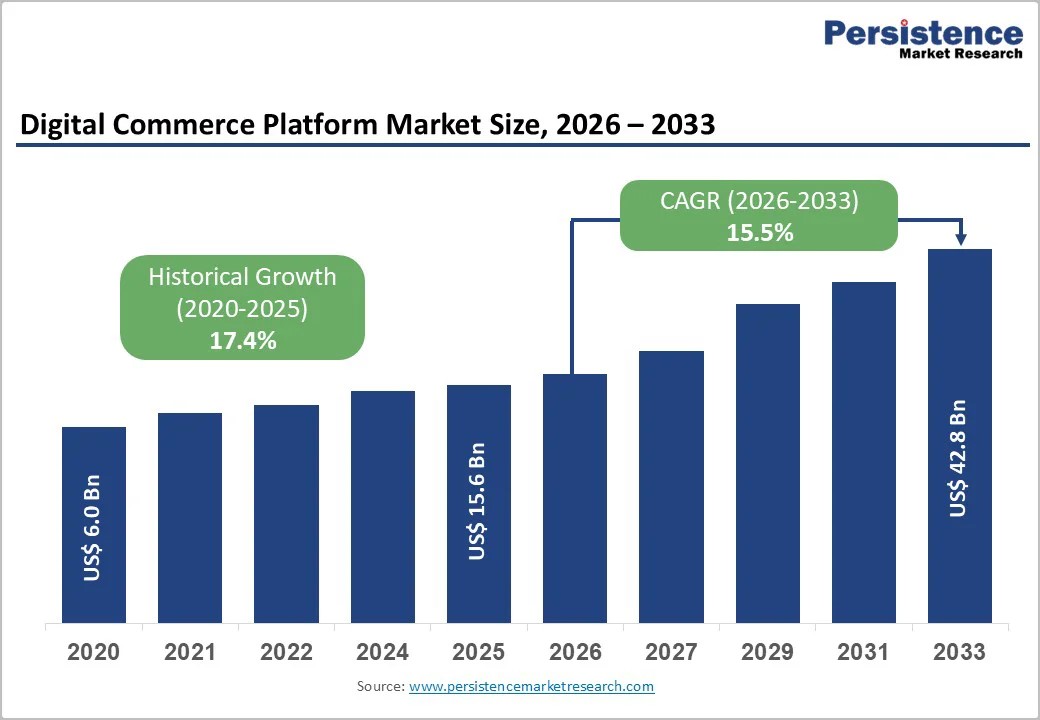
The digital commerce platform market set to grow from US$ 15.6 Bn in 2026 to US$ 42.8 Bn by 2033, registering a strong CAGR of 15.5% during the forecast period
BRENTFORD, ENGLAND, UNITED KINGDOM, March 10, 2026 /EINPresswire.com/ -- The Digital Commerce Platform Market is experiencing strong global momentum as enterprises increasingly transition toward digital-first retail strategies. The market is expected to grow from US$ 15.6 billion in 2026 to US$ 42.8 billion by 2033, expanding at a CAGR of 15.5% during the forecast period. This growth reflects the widespread adoption of online retail ecosystems, increasing smartphone penetration, and rising consumer preference for seamless omnichannel shopping experiences. Businesses across industries are investing in digital commerce platforms to enhance customer engagement, streamline operations, and enable scalable online selling capabilities.
The market’s expansion is primarily driven by the surge in internet accessibility and mobile commerce, particularly across emerging economies. Among application segments, apparel and fashion dominates with nearly 28% market share, supported by social commerce integration, influencer-driven marketing, and AI-powered product recommendations. North America leads the global market with 28.2% revenue share, attributed to advanced payment infrastructure, mature e-commerce ecosystems, and early adoption of omnichannel commerce technologies among retailers seeking competitive differentiation.
𝐆𝐞𝐭 𝐚 𝐒𝐚𝐦𝐩𝐥𝐞 𝐏𝐃𝐅 𝐁𝐫𝐨𝐜𝐡𝐮𝐫𝐞 𝐨𝐟 𝐭𝐡𝐞 𝐑𝐞𝐩𝐨𝐫𝐭: https://www.persistencemarketresearch.com/samples/33044
Key Highlights from the Report
The global digital commerce platform market is projected to reach US$ 42.8 billion by 2033, growing at a 15.5% CAGR.
North America dominates the global market due to mature e-commerce infrastructure and strong omnichannel adoption.
Asia Pacific is the fastest-growing region, expanding at 20.5% CAGR through 2033.
Apparel & Fashion remains the leading application segment with around 28% market share.
Market Segmentation Analysis
The digital commerce platform market is segmented based on business model, deployment mode, and application industry, each playing a vital role in shaping industry demand. In terms of business model, Business-to-Consumer (B2C) platforms dominate the market, accounting for nearly 46% of global revenue. The widespread adoption of online retail stores, high-frequency consumer purchases, and mobile-first shopping behavior contribute to the strong position of B2C platforms. Meanwhile, Business-to-Business (B2B) digital commerce platforms are rapidly gaining traction as enterprises digitize procurement processes and integrate automated purchasing workflows.
From a deployment perspective, cloud-based platforms lead the market with about 60% share, as businesses increasingly prefer flexible and scalable digital infrastructure. Cloud deployment eliminates expensive on-premise IT infrastructure while enabling real-time updates, security patching, and seamless integration with analytics, AI engines, and customer data platforms. In terms of application, industries such as apparel & fashion, electronics, food & beverages, healthcare, and consumer goods utilize digital commerce platforms to manage inventory, personalize customer experiences, and streamline digital transactions across multiple sales channels.
Regional Insights
North America remains the most mature market for digital commerce platforms due to advanced internet infrastructure, high e-commerce penetration, and strong digital payment ecosystems. The United States continues to dominate regional demand as enterprises deploy omnichannel commerce platforms that integrate e-commerce websites, mobile apps, and physical retail stores into a unified digital experience.
Asia Pacific, on the other hand, is the fastest-growing region in the digital commerce platform market. Rapid smartphone adoption, expanding internet access, and rising digital payment usage in countries such as India, China, and Southeast Asian nations are driving the region’s impressive 20.5% CAGR growth.
𝐃𝐨 𝐘𝐨𝐮 𝐇𝐚𝐯𝐞 𝐀𝐧𝐲 𝐐𝐮𝐞𝐫𝐲 𝐎𝐫 𝐒𝐩𝐞𝐜𝐢𝐟𝐢𝐜 𝐑𝐞𝐪𝐮𝐢𝐫𝐞𝐦𝐞𝐧𝐭? 𝐑𝐞𝐪𝐮𝐞𝐬𝐭 𝐂𝐮𝐬𝐭𝐨𝐦𝐢𝐳𝐚𝐭𝐢𝐨𝐧 𝐨𝐟 𝐑𝐞𝐩𝐨𝐫𝐭: https://www.persistencemarketresearch.com/request-customization/33044
Market Drivers
The growing adoption of omnichannel commerce strategies is a major driver fueling the expansion of the digital commerce platform market. Retailers are increasingly integrating multiple sales channels—including online stores, mobile applications, social media platforms, and physical outlets—into a unified commerce ecosystem. This integrated approach allows businesses to deliver consistent customer experiences, improve operational efficiency, and increase overall revenue through expanded digital reach.
Additionally, artificial intelligence (AI) and advanced analytics integration is transforming digital commerce platforms into intelligent systems capable of delivering hyper-personalized customer journeys. AI-driven product recommendations, predictive inventory management, and automated marketing campaigns significantly improve conversion rates and customer retention.
Market Restraints
Despite rapid growth, the digital commerce platform market faces several challenges, with cybersecurity threats and online transaction fraud being among the most significant. As online transactions increase, cybercriminals are targeting digital retail platforms with sophisticated fraud techniques, data breaches, and phishing attacks. Businesses must invest heavily in advanced security technologies such as encryption, fraud detection systems, and multi-factor authentication.
Another constraint is the complexity and cost of logistics and last-mile delivery operations. Even with advanced technology platforms, the physical delivery of goods remains operationally challenging, especially in developing regions with limited logistics infrastructure. Rising shipping costs and increasing consumer expectations for same-day delivery also create pressure on merchant profitability.
Market Opportunities
The rise of social commerce and influencer-driven purchasing behavior presents a major growth opportunity for the digital commerce platform market. Platforms such as social media marketplaces and live-stream shopping channels are redefining online retail by combining product discovery with entertainment-driven engagement. Businesses are increasingly integrating shoppable posts, live product demonstrations, and influencer collaborations to drive online sales.
Another significant opportunity lies in the development of industry-specific digital commerce platforms tailored to sectors such as healthcare, automotive, and financial services. These specialized platforms integrate regulatory compliance frameworks, industry-specific workflows, and advanced analytics capabilities that enable businesses to manage complex transactions more efficiently.
𝐁𝐮𝐲 𝐍𝐨𝐰 𝐭𝐡𝐞 𝐃𝐞𝐭𝐚𝐢𝐥𝐞𝐝 𝐑𝐞𝐩𝐨𝐫𝐭: https://www.persistencemarketresearch.com/checkout/33044
Company Insights
The digital commerce platform market features a competitive landscape comprising global technology providers, SaaS platform developers, and regional e-commerce solution vendors. Leading companies focus on innovation, AI-powered personalization, headless commerce architecture, and omnichannel integration to maintain competitive advantage.
Key Players Operating in the Digital Commerce Platform Market:
Shopify
eBay
Squarespace
BigCommerce
Amazon
Adobe Commerce
SAP
Oracle
Salesforce
WooCommerce
OpenCart
Wix
PrestaShop
Ecwid
Weebly
Recent Developments
In September 2025, BigCommerce announced the launch of its B2B Quotes AI Assistant, powered by Google Vertex AI, enabling merchants to generate personalized proposals significantly faster and improving sales conversion efficiency.
In November 2025, Commerce introduced two new Feedonomics applications designed to help Shopify merchants optimize product listings, streamline multichannel order management, and automate data governance for improved operational efficiency.
Related Reports:
Caesium and Hydrogen Maser Atomic Clock Market
Pooja Gawai
Persistence Market Research
+1 646-878-6329
email us here
Visit us on social media:
LinkedIn
Instagram
Facebook
YouTube
Legal Disclaimer:
EIN Presswire provides this news content "as is" without warranty of any kind. We do not accept any responsibility or liability for the accuracy, content, images, videos, licenses, completeness, legality, or reliability of the information contained in this article. If you have any complaints or copyright issues related to this article, kindly contact the author above.
