

Suffolk and Westchester Towns: Grievance Deadlines Approaching

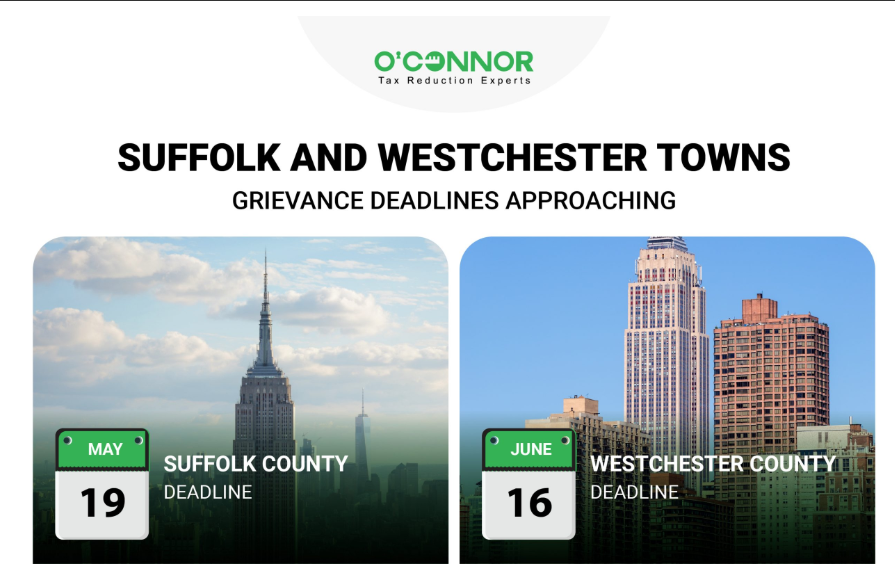
Suffolk and Westchester Towns Grievance Deadlines Approaching
O'Connor discusses how Suffolk and Westchester towns grievance deadlines are approaching.
NEW YORK, NY, UNITED STATES, April 29, 2026 /EINPresswire.com/ --The suburbs of New York City have some of the highest property taxes in the nation, and many exceed even the Big Apple itself. Strategically located outside of NYC’s urban sprawl, these enclaves of open space and scenic land attract millions of people who want to own their own land. From Long Island to Westchester, people living in these prime locales are seeing their taxes increase every year, even above what had previously been deemed unreasonable.
While most already use every exemption available to them, there is another option in property tax grievances. Called appeals in NYC itself, grievances allow taxpayers to challenge the taxable value of their property against that put forward by the assessor. Grievances are subject to strict deadlines, and while Nassau County recently saw its deadline pass, Suffolk and Westchester counties are set to face their deadlines soon.
The Tentative Assessment Roll
Before filing a grievance, a taxpayer must review the tentative assessment roll. This document details a property’s value and characteristics. Before assessing value, focus on characteristics such as property size, classification, improvements, room count, and other key factors. Correct any errors, including missing exemptions, which must be double-checked. Once verified, analyze the values. If these are excessive or inconsistent with comparable properties, filing a grievance is usually necessary.
Suffolk County Deadline is May 19
On the eastern half of Long Island, Suffolk County is one of the premier destinations outside of New York City. While property taxes are not quite as high as neighboring Nassau County, Suffolk still has some of the highest values in the nation. This is thanks to limited space, some of the best schools in the country that require funding, and restrictive zoning laws preventing the construction of more housing, especially for multiple families. Competition for both business and residential real estate in Suffolk County is fierce, and this drives up property values even more.
To complicate matters, there are only a few scant weeks between the tentative assessment roll and the grievance deadline. Typically, in New York, there are at least 30 days from the roll to the deadline. This is extremely shortened for Suffolk County, with the roll coming out around May 1 and the deadline being set for May 19. This means a taxpayer needs to study their roll, gather evidence, and file an appeal with all the paperwork by May 19. Ideally, a taxpayer in Suffolk would gather as much evidence as possible before the roll comes out, though this can be difficult if they do not know what they are challenging.
Many Westchester County Towns Have a Deadline of June 16
While Suffolk has a unified deadline, Westchester County divides its deadlines between towns. Yonkers, for instance, has its deadline set for November. White Plains, on the other hand, has its deadline in January. A smattering of towns, including New Rochelle and Sleepy Hollow, saw their deadlines pass in February. However, the lion’s share of deadlines is set for the third Tuesday in June, which is June 16 in 2026.
Like Suffolk, Westchester County taxpayers will have a short window to file a grievance. For many towns, the tentative assessment roll will be launched on June 1, giving only a few weeks for homeowners and businesses to put together all of their evidence and paperwork. To get a head start on everything, if property owners wish to pursue a grievance in Westchester County, it is best to start gathering evidence as soon as possible, even before the tentative roll is released. While owners may not know some issues, it is best to gather photographs and sales records of similar homes, dating back three years. This is also the perfect time to sign up with an expert property tax firm, as the evidence can often be gathered for the owner, giving them an edge when the deadline finally comes.
Westchester Towns with a Deadline of June 19, 2026
Bedford
Cortlandt
Eastchester
Greenburgh
Harrison
Lewisboro
Mamaroneck
Mount Kisco
Mount Pleasant
Mount Vernon
New Castle
North Castle
North Salem
Ossining
Peekskill
Pelham
Pound Ridge
Rye
Scarsdale
Somers
Yorktown
Missed Deadlines
If a grievance deadline is missed, there is no way to get a second chance. While the following year’s taxes can be grieved at the next deadline, there is no way to go back and retroactively lower taxes. Thanks to the high taxes in places like Suffolk and Westchester, meeting these deadlines is crucial to protecting properties now and in the future. While property owners might not be able to go back and get a reduction if they missed their deadline, there is always a shot at the following year. This is a good time to sign up with an expert, so that they will be prepared for the next assessment roll and deadline.
Evidence Needed
Due to the high-dollar nature of grievances in Westchester and on Long Island, they often require significant evidence to land a reduction. Evidence depends on the grounds that are grieved. If owners want to challenge based on unequal assessment, then they will need records of multiple nearby properties with similar characteristics. If they are challenging overassessment, they will need the sales records for several properties that are close to theirs in both location and characteristics, usually dating back three years. Businesses will need to have an accurate accounting of their income and expenses, which can help demonstrate the true value of a piece of commercial real estate.
About O'Connor:
O’Connor is one of the largest property tax consulting firms, representing 185,000 clients in 49 states and Canada, handling about 295,000 protests in 2024, with residential property tax reduction services in Texas, Illinois, Georgia, and New York. O’Connor’s possesses the resources and market expertise in the areas of property tax, cost segregation, commercial and residential real estate appraisals. The firm was founded in 1974 and employs a team of 1,000 worldwide. O’Connor’s core focus is enriching the lives of property owners through cost effective tax reduction.
Property owners interested in assistance appealing their assessment can enroll in O’Connor’s Property Tax Protection Program ™. There is no upfront fee, or any fee unless we reduce your property taxes, and easy online enrollment only takes 2 to 3 minutes.
Patrick O'Connor, President
O'Connor
+1 713-375-4128
email us here
Visit us on social media:
LinkedIn
Instagram
Facebook
YouTube
TikTok
X
Legal Disclaimer:
EIN Presswire provides this news content "as is" without warranty of any kind. We do not accept any responsibility or liability for the accuracy, content, images, videos, licenses, completeness, legality, or reliability of the information contained in this article. If you have any complaints or copyright issues related to this article, kindly contact the author above.
